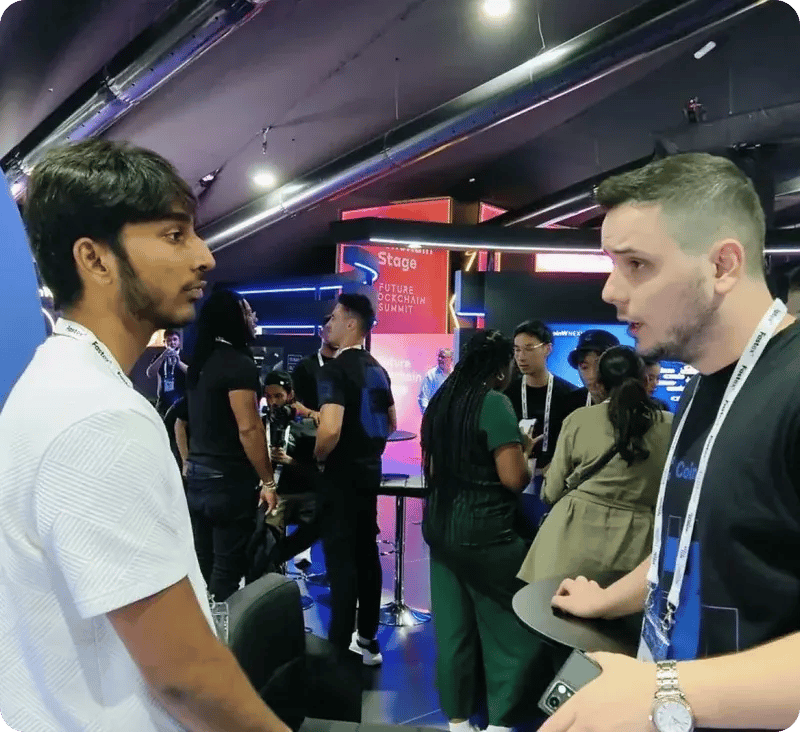
A starting chapter, with seven semesters still ahead. This notebook is where I want to connect the people I learn from, the places I explore, and the ideas I test as I learn the whole journey from product to business.
A starting point. Seven semesters ahead. Room for multiple projects and learnings in each chapter.
Semester 01.
Projects, experiments, conversations, and lessons from this semester stay together here. Each entry has its own image, question, analysis, evidence, and next step.
0 published entries · 3 example formats
Example format · Founder conversation
The decision behind the first customer.
This is an example format, not a completed project or a claim of a real meeting.
Example format: follow a founder’s reasoning, the constraints around a decision, and the answer that deserves a second look.
Conceptual illustration · Example format
The question
What changed between the original idea and something a customer chose?
The learning in brief
What was the founder trying to understand or solve?
Which decision changed after contact with a customer?
What did the conversation clarify, and what would need further evidence?
Evidence and supporting work
A dated conversation note, a public source, and any quote or photograph approved for sharing.
Understand the problem
Identify the customer, the task they were trying to complete, and the workaround they used. Separate the founder’s interpretation from what customers actually said or did.
Break it into decisions
Trace the original assumption, the evidence that challenged it, and the sequence of decisions that followed. Ask which constraint mattered most: time, trust, cost, capability, or access.
Test the solution
Record what was offered first, what was deliberately left out, and how the founder checked whether it solved the customer’s real problem.
Examine the business
Ask who used it, who paid, how the first customer found it, what it cost to deliver, and what would make someone return.
Reflect and continue
Write down what the conversation changed, what remains uncertain, and the next person, observation, or small test that could resolve it.
Example format · Company visit
The work behind the experience.
This is an example format, not a completed project or a claim of a real meeting.
Example format: connect an observation from a company visit to the people, systems, and trade-offs that make the business work.
Conceptual illustration · Example format
The question
What has to happen behind the scenes for a customer promise to hold?
The learning in brief
Which process or part of the business was visible?
What did I directly observe, and what did someone explain?
Which detail changed my understanding of the customer experience?
Evidence and supporting work
A dated observation, a process sketch, or a public reference, with confidential details left out.
Understand the problem
Start with the promise made to a customer. Identify where the customer could experience delay, confusion, cost, or disappointment.
Map the work
Break the process into steps: request, decision, handoff, delivery, and follow-up. Note who is responsible and where information or work can get stuck.
Consider a solution
Choose one observed bottleneck. Compare a simpler process change with a tool or AI-assisted approach before assuming that new software is needed.
Examine the business
Connect the process to delivery cost, quality, capacity, and the reason a customer would choose this business again.
Reflect and continue
Distinguish what was directly observed from what was explained. Identify the evidence needed before recommending a change.
Example format · Applied learning
When the idea meets a test.
This is an example format, not a completed project or a claim of a real meeting.
Example format: record the starting assumption, the thing made or tested, the evidence, and the next decision.
Conceptual illustration · Example format
The question
What did the attempt reveal that the original explanation could not?
The learning in brief
What question did this attempt set out to answer?
What did I make or contribute, and what happened?
Which assumption changed, and what would I try next?
Evidence and supporting work
A prototype or demonstration, a short evidence record, and a clear account of the work’s limits.
Understand the problem
Name a specific person and the outcome they need. Record the current workaround, how often the problem occurs, and the cost of leaving it unresolved.
Break it into a sequence
Map the task step by step. Separate symptoms from possible causes, list constraints and unknowns, and choose the assumption most likely to change the decision.
Build the smallest useful test
Compare possible approaches, including doing the task manually. Build only enough to test the riskiest assumption; use AI where its output can be checked.
Test business viability
Ask who would pay, why they would choose this solution, how they would find it, and whether price can cover acquisition, delivery, and support.
Learn and decide
Keep the result, including a disappointing one. Decide whether to improve, change direction, or stop, and explain the evidence behind that choice.
Semester 02.
Projects, experiments, conversations, and lessons from this semester stay together here. Each entry has its own image, question, analysis, evidence, and next step.
0 published entries
Semester 02 · No entries yet
Ready for projects. And what they teach me.
This chapter can hold multiple projects and learnings. No entries have been published for this chapter yet.
Semester 03.
Projects, experiments, conversations, and lessons from this semester stay together here. Each entry has its own image, question, analysis, evidence, and next step.
0 published entries
Semester 03 · No entries yet
Ready for projects. And what they teach me.
This chapter can hold multiple projects and learnings. No entries have been published for this chapter yet.
Semester 04.
Projects, experiments, conversations, and lessons from this semester stay together here. Each entry has its own image, question, analysis, evidence, and next step.
0 published entries
Semester 04 · No entries yet
Ready for projects. And what they teach me.
This chapter can hold multiple projects and learnings. No entries have been published for this chapter yet.
Semester 05.
Projects, experiments, conversations, and lessons from this semester stay together here. Each entry has its own image, question, analysis, evidence, and next step.
0 published entries
Semester 05 · No entries yet
Ready for projects. And what they teach me.
This chapter can hold multiple projects and learnings. No entries have been published for this chapter yet.
Semester 06.
Projects, experiments, conversations, and lessons from this semester stay together here. Each entry has its own image, question, analysis, evidence, and next step.
0 published entries
Semester 06 · No entries yet
Ready for projects. And what they teach me.
This chapter can hold multiple projects and learnings. No entries have been published for this chapter yet.
Semester 07.
Projects, experiments, conversations, and lessons from this semester stay together here. Each entry has its own image, question, analysis, evidence, and next step.
0 published entries
Semester 07 · No entries yet
Ready for projects. And what they teach me.
This chapter can hold multiple projects and learnings. No entries have been published for this chapter yet.
Semester 08.
Projects, experiments, conversations, and lessons from this semester stay together here. Each entry has its own image, question, analysis, evidence, and next step.
0 published entries
Semester 08 · No entries yet
Ready for projects. And what they teach me.
This chapter can hold multiple projects and learnings. No entries have been published for this chapter yet.
Entries marked “Example format” demonstrate the layout and are not completed work. Each semester’s counts and navigation reflect its own projects and learnings.